Vulcan rocket failure: ULA loses 40 Amazon Leo satellites 10 minutes after launch from Florida
It is the first outright failure of a United Launch Alliance rocket since the company was formed in 2006, Spaceflight Now said.
Written with AI assistance from the sources listed below, then checked against them and reviewed by an editor. How our newsroom works
The Vulcan rocket failure on Sunday cost United Launch Alliance (ULA) a payload of 40 Amazon satellites. The rocket suffered an anomaly 10 minutes into its flight from Cape Canaveral, Florida, and did not reach orbit, Spaceflight Now reported. It lifted off at 12.40 pm EST (11.10 pm IST).
What ULA said after the Vulcan rocket failure
“Based on data received by our Launch Director, we confirm that the Vulcan vehicle launched from Space Launch Complex 41 suffered an anomaly 10 minutes into the flight and failed to deliver the Amazon mission to orbit,” ULA said in an update on X about 50 minutes after launch, Space.com reported. The company added: “Since the anomaly just occurred, we don’t have any specific data yet to understand what occurred today.”
ULA said it is “committed to full transparency with our customers” and that they will have visibility into the investigation, Spaceflight Now reported. The cause is not yet public. NASA Administrator Jared Isaacman promised assistance if needed.
Amazon’s own Amazon Leo mission updates page lists the flight as Leo Vulcan 1, carrying 40 satellites from Space Launch Complex-41 at 12.40 pm EST on Sunday, 15 November. An editor’s note on that page says ULA experienced an anomaly with the Vulcan rocket that day.
Key numbers
- 40: Amazon internet satellites lost with the rocket, per Space.com.
- 10 minutes: how far into the flight the anomaly happened, per Space.com.
- 12.40 pm EST: liftoff time from pad 41 at Cape Canaveral Space Force Station, per Spaceflight Now.
- Fifth: the number of this Vulcan flight, and the first in nine months, per Spaceflight Now.
- 38: Vulcan flights bought by Amazon, of which this was the first, per Spaceflight Now.
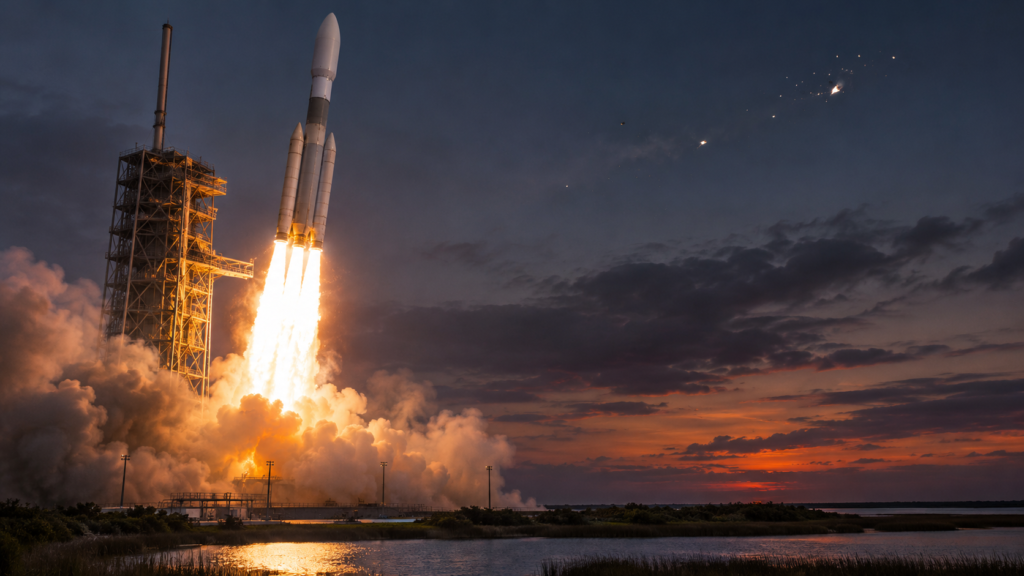
Vulcan Leo 1: what the rocket was carrying
The mission was the first of 38 Vulcan flights that Amazon bought to launch its satellites, Spaceflight Now said. They are designed to compete with Starlink and other space-based internet providers. More than 3,300 satellites are needed to complete the Amazon Leo constellation. Amazon “will now have to wait on ULA’s failure investigation to run its course before trying again with a Vulcan.”
ULA Vulcan record before Sunday
It was the first outright failure of a ULA rocket since the company, a partnership between Boeing and Lockheed Martin, was formed in 2006. The Vulcan was returning after nine months on the ground, while ULA and booster supplier Northrop Grumman worked on nozzle problems with the strap-on solid boosters that hit two earlier flights.
ULA chief executive Mark Peller told Aviation Week before launch that the company had “identified three credible causes” of the nozzle issue. Space.com wrote that “a different, more serious problem cropped up today”. The U.S. Space Force had put Vulcan launches of national security payloads on hold pending more analysis, Spaceflight Now said.
NIS has covered the space sector closer to home, including India’s first private space debris removal facility in Hyderabad.
What happens next for ULA and Amazon
ULA said it will “work closely with our customer and other appropriate organisations to find the cause, determine the appropriate corrective action and return to flight as quickly as possible.” No date has been given. After the Vulcan rocket failure, engineers will review telemetry, and the rocket faces a potentially significant grounding.
Amazon bought 38 Vulcan flights and this was the first, so the loss delays a launcher meant to carry much of the more than 3,300 satellites its network needs. The Space Force had already paused national security Vulcan launches over booster nozzle problems, so a second, different fault raises the stakes for the whole programme. The cause, and how long Vulcan stays grounded, will decide when Amazon and ULA fly again.
Named in this story
Sources
- ULA suffers first outright failure with loss of Vulcan rocket carrying 40 Amazon Leo satellites (Spaceflight Now)
- Vulcan Centaur rocket fails during return-to-flight launch, 40 Amazon satellites lost (Space.com)
- US rocket firm ULA fails to deploy 40 Amazon Leo satellites after flight anomaly (Anadolu Agency)
- Amazon Leo mission updates (Amazon) Official